TPU 3D Printing

TPU 3D Printing Service

Rubber-like flexibility with print precision — for seals, grips, and wearables.

FDM Process±0.2 mm toleranceLayer height 0.1 – 0.32 mmVaries with grade

Best for

Gaskets, seals, phone cases, grips, flexible joints, orthotics, shoe soles

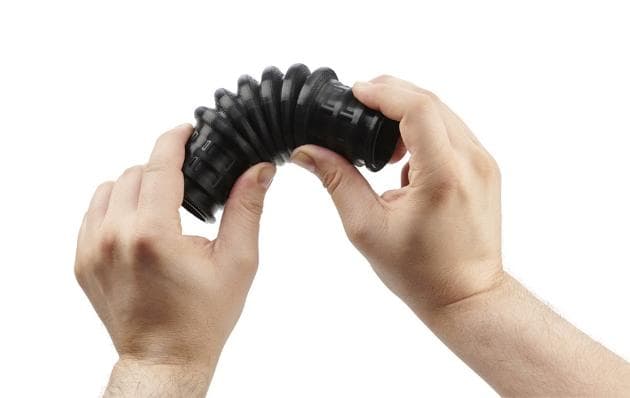
TPU (Thermoplastic Polyurethane) is a flexible polymer with the feel and behaviour of rubber. Printed parts flex, stretch, absorb impact and grip surfaces — behaviour you simply cannot get from a rigid filament.

Because it deforms instead of cracking, TPU is the material for seals and gaskets, protective bumpers, grips and handles, phone and wearable cases, and orthotics. A TPU part that takes a hard impact bounces back; the same part in ABS would shatter.

TPU is also remarkably abrasion-resistant, which is why it outlasts rigid plastics in friction applications such as conveyor guides, cable strain relief and grip surfaces. Flexible TPU prints more slowly and needs slower print speeds, which we account for in the quote automatically.
TPU Properties at a Glance

Shore Hardness:85A – 95A — ranges from very soft to semi-rigid depending on grade
Elongation at Break:400–600% — extreme flexibility without tearing
Abrasion Resistance:Outstanding — significantly outlasts rigid materials in friction applications
Chemical Resistance:Good resistance to oils, fuels, and moderate acids

TPU Technical Specifications

Technical specifications for TPU FDM 3D printing
ProcessFDM
Shore Hardness85A – 95A
Tensile Strength~40–50 MPa
Elongation at Break400–600%
Heat Deflection Temp.Varies with grade
Abrasion ResistanceVery high
Chemical ResistanceOils, fuels, moderate acids

Typical Applications

  • ✓Gaskets and O-ring substitutes
  • ✓Seals and protective boots
  • ✓Phone, tablet and wearable cases
  • ✓Grips, handles and ergonomic aids
  • ✓Cable management and strain relief
  • ✓Orthotics, prosthetics and sports gear

Limitations to Know

  • !Prints more slowly than rigid filaments, so machine time is higher
  • !Fine details and sharp corners are harder to resolve on soft grades
  • !Soft 85A grades may sag on small footprints — a small brim helps
  • !Not suitable for load-bearing rigid applications

How We Print TPU

  • Printed at reduced speed with direct-drive extrusion for clean flexing layers
  • Shore hardness is selected per job based on your flexibility requirement
  • Layer adhesion is tuned for maximum stretch without tearing

TPU 3D Printing FAQ

Which TPU hardness should I choose?+

95A is semi-rigid and best for load-bearing flexible parts, wearables and phone cases. 85A is noticeably softer and better for gaskets, grips and anything that needs to stretch a lot. If you are unsure, 95A is the safe general-purpose choice.

Is TPU as strong as PLA or ABS?+

Not in tensile strength — roughly 40–50 MPa. But TPU handles impact completely differently: it absorbs energy and returns to shape instead of cracking, and it outlasts rigid materials under abrasion. For flexible, impact-absorbing and high-wear parts it is far better than a rigid alternative.

Can you print TPU in multiple colours?+

Yes. Flexible multi-material printing lets us place hard and soft TPU in a single part, which is ideal for grips, bumpers and wearables where a rigid structure with flexible contact zones is wanted.

How accurate are TPU parts?+

TPU is soft, so very tight tolerances are harder to hold than on rigid materials. For gaskets and snap fits we design in a small interference fit — typically 0.2–0.4 mm — which produces an excellent seal or click in practice.

Compare with other materials

Also in Engineering FDM Materials: browse all materials

Get an instant TPU 3D printing quote

Upload your STEP or STL file and see your exact price — material, machine time and delivery included — in under two minutes.