Carbon Fibre-Reinforced (CFRP) 3D Printing

Carbon Fibre-Reinforced (CFRP) 3D Printing Service

Aerospace-grade stiffness at minimal weight — where strength-to-weight ratio is critical.

FDM Process±0.2 mm toleranceLayer height 0.1 – 0.32 mm~120 – 140 °C depending on grade

Best for

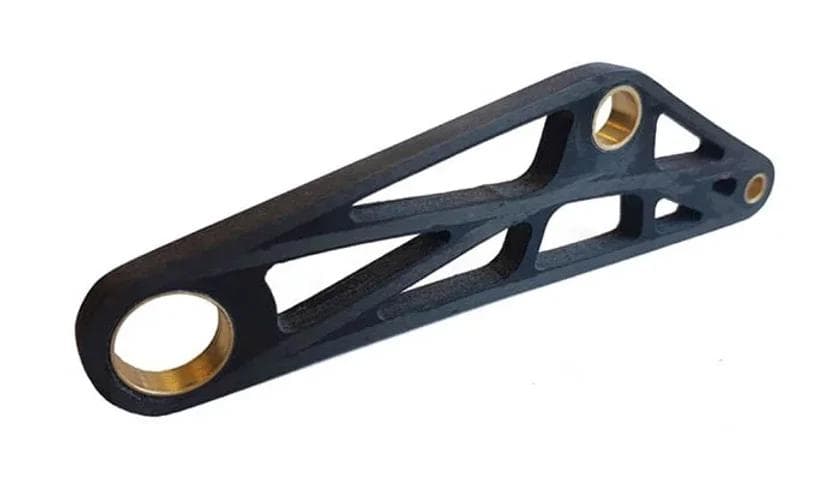
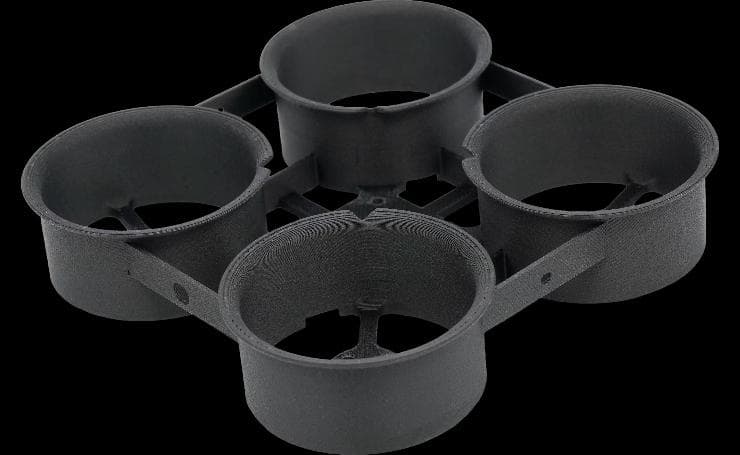
Drone frames, motorsport brackets, structural jigs, lightweight robotics components

Carbon fibre reinforced filament is a high-performance polymer composite — short chopped carbon fibres suspended in a nylon or PET matrix. The result is a part with the stiffness of aluminium at roughly half the density, and it prints on ordinary FDM equipment.

The dominant benefit is specific stiffness. A carbon-reinforced bracket will deflect dramatically less than an ABS one of identical geometry while weighing significantly less, which matters when you are designing drone frames, robotics arms, motorsport fixtures or anything weight-critical.

Carbon reinforcement also raises heat deflection temperature, dimensional stability and chemical resistance compared with unfilled polymers. The trade-offs are real and worth knowing: the abrasive fibres wear brass nozzles rapidly, surface finish is matte, and the material is unforgiving of thin unsupported features.
Carbon Fibre-Reinforced (CFRP) Properties at a Glance

Tensile Strength:Up to 150 MPa — 2–3x stronger than standard materials in the same weight class
Stiffness:Extremely high flexural modulus — near-zero deflection under load; rivals aluminium
Weight:Lightweight — high specific stiffness at roughly half the density of aluminium
Abrasion on Tooling:Highly abrasive — requires hardened steel nozzle; standard brass wears rapidly

Carbon Fibre-Reinforced (CFRP) Technical Specifications

Technical specifications for Carbon Fibre-Reinforced (CFRP) FDM 3D printing
ProcessFDM
MatrixPA (nylon) or PET
FibreShort chopped carbon fibre
Fibre LoadingTypically 10–20% by weight
Density~1.1 – 1.2 g/cm³
Tensile StrengthUp to ~150 MPa
Heat Deflection Temp.~120 – 140 °C depending on grade
Surface FinishMatte, textured

Typical Applications

  • ✓Drone and UAV frames and arms
  • ✓Robotics links and lightweight brackets
  • ✓Motorsport and bicycle components
  • ✓Camera and sensor mounting rigs
  • ✓Lightweight structural jigs and fixtures
  • ✓Enclosures needing stiffness without weight

Limitations to Know

  • !Very abrasive — destroys brass nozzles; hardened steel or ruby is mandatory
  • !Matte, slightly textured surface; not suitable for show-piece finishes
  • !Brittle in thin sections and short-grain directions
  • !Requires a heated, enclosed chamber and dry filament
  • !Higher material cost than unfilled engineering polymers

How We Print Carbon Fibre-Reinforced (CFRP)

  • Printed with hardened steel nozzles replaced on a scheduled cycle
  • Chamber heated well above the glass transition point to minimise warp
  • Part orientation prioritises fibre alignment along the primary load path

Carbon Fibre-Reinforced (CFRP) 3D Printing FAQ

Is carbon fibre 3D printing as strong as aluminium?+

In stiffness-to-weight terms, yes — carbon-reinforced filament can rival aluminium at roughly half the density. In absolute strength aluminium still wins, and carbon fibres loaded poorly (across the layer lines) are much weaker, which is why we orient parts so the fibres run with your load path.

What nozzle do carbon fibre filament needs?+

A hardened steel or ruby nozzle. Carbon fibre is highly abrasive and will wear out a brass nozzle very quickly, sometimes within a single job. All of our carbon fibre machines run hardened nozzles on a fixed replacement schedule.

Is carbon fibre safe to print?+

Yes. The fibres are encapsulated in the polymer matrix and the finished part is a stable solid composite. As with any engineering polymer we print in an extracted, filtered chamber to manage emissions.

Can carbon fibre parts be smooth or painted?+

The natural finish is matte and textured. It can be sanded and painted, though filling the texture takes more preparation than for unfilled filaments. If you need a smooth, glossy surface, DLP resin is usually the better choice.

Compare with other materials

Also in Advanced Engineering FDM Materials: browse all materials

Get an instant Carbon Fibre-Reinforced (CFRP) 3D printing quote

Upload your STEP or STL file and see your exact price — material, machine time and delivery included — in under two minutes.